Getting Lost

Way-finding in Honeycomb Townships

The concern about ‘getting lost in a maze' is one that I've been working on for a while. It's true that winding roads can be disorienting, but you would never say that that would justify railroading a straight route across hilly land.

In small scale development, maintaining a sense of location would be a smaller problem. Also, I think a bigger development that is composed of clearly defined sectors each with its own identity, would be easier to navigate.

If the issues of scale and monotonous repetition are handled badly, even grid layouts can be a problem to navigate, particularly where the sign-posting is poor (which is often true in Malaysia).
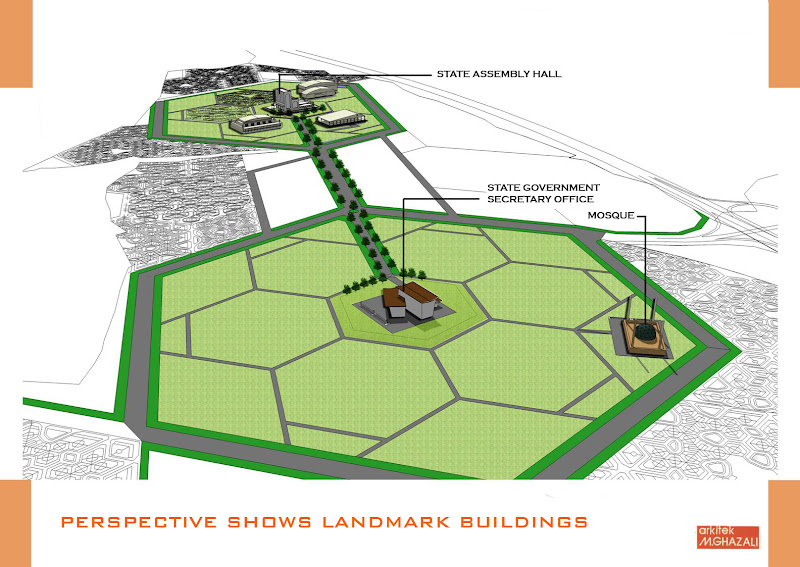

The State Secretariat and the State Assembly Hall define the main boulevard in this proposal

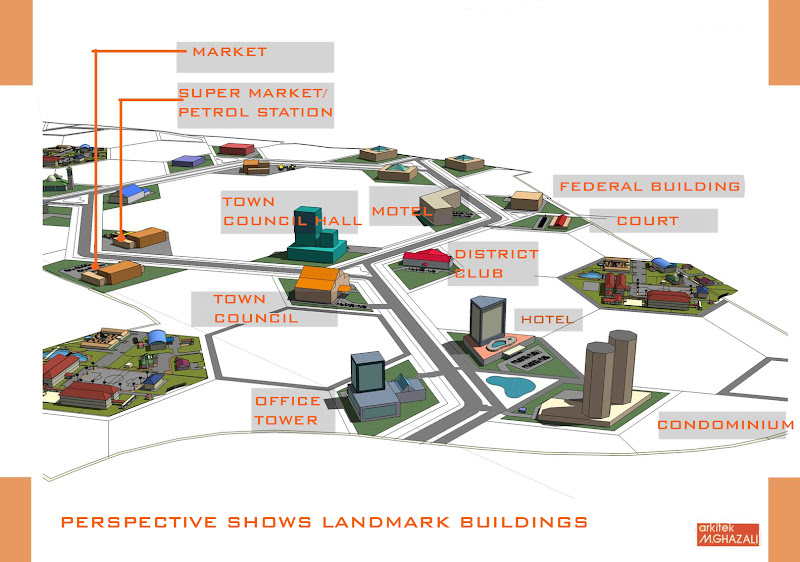
Landmarks help. I've been working on a honeycomb plan for a new district town layout, and thought about how zigzagging roads can provide opportunities for vistas. On straight roads we see only the road disappearing into the horizon, but prominent buildings where the road bends can become give each stretch of the road its own identity.


The edges of the hexagonal precincts become geographical markers that help provide identity to the roads that lead towards them
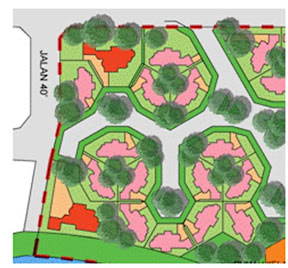
Who looks after the courtyard green?

Having many decentralized small parks instead of one centralized neighbourhood park, would be difficult to maintain, is one of the objections we often receive, but no as yet from park managers themselves.

In Malaysian cities and big towns, one department would look after parks, another one would look after roads. One department will look after the soft and hard landscaping in the parks, including cutting the grass. The road department will maintain and clean the roads including looking after the landscaping and cutting the grass on the side table (or sidewalk).

There is no problem with maintaining the courtyards when you think of it as something which is being done by the road department. After all they are just small pockets of green in the middle of the looping cul-de-sacs, just as easy to maintain as the side-tsble or sidewalks.

Can the Garbage Truck access a Honeycomb Cul.de-sac?

The truck that collects and compacts garbage is about the same size as a fire engine. See the same question about fire engines earlier:

Does the Honeycomb layout take into account the sun's path?

Malaysia is an equatorial rainforest, hot and humid all year round. Ideally, windows would face N-S, avoiding the morning sun in the East, and certainly the afternoon sun in the West. Yet, if the windows are shaded, heat gain can be minimized. A comparison of two quadruplex houses, one in the N-S orientation, the other in E-W orientation shows only a small difference in temperature the hottest period of the year (details later).


Even so, this simulation does not take into account the potential shade that can be gained from planting fast-growing trees that we have - that can grow 40’ high and almost the same across within 5 years. In fact, one of the main reason for the Honeycomb concept is to have parks, small, yet large enough to grow such trees. There just isn’t enough space on the standard 40’ right of way in our housing estates.

Outside of the tropics, where we want mainly south-facing windows, the Honeycomb layout with linked houses may not be suitable, because some houses will have to face elsewhere. But for detached single family homes in a Honeycomb layout, we can design the house to have windows facing where we want them.

Can Fire Trucks access a Honeycomb Cul-de-sac?

The drawing below shows how a fire engine can easily turn round a honeycomb cul-de-sac. There is plenty of space!


Will consumers accept honeycomb houses?

We had done about 10 opportunity surveys prior to 2006 at exhibition events and lectures to gauge the response of consumers to Honeycomb Housing. Simple methodalogies were adopted, but responses were clear: consumers preferred Honeycomb Housing, as an alternative to terrace houses by a big margin.
In 2006, developers who use our potential clients commissioned a team from Universiti Putra Malaysia to undertake broader surveys to test the market potential.
Three surveys were done. Two opportunity surveys were conducted at Kuantan and Johor Bahru, the aim being to gauge the response of government civil servants, an important market category in both cities. Though the survey was not random, about 20% of the total number of civil servants in the locations selected volunteered to take part in the survey.
In the two surveys about 95% of respondents preferred Honeycomb Houses to Terrace Houses and conventional housing.
In a third exercise, a random selection of households in Johor Jaya was surveyed. In this survey where ethnic Chinese Malaysian formed the majority of households, two-thirds of total respondents preferred Honeycomb Housing.
The report on this suvey can be access in the Johor Jaya Survey website.